Friday, March 11, 2011

Tapping the Diaspora: How Does St. Louis Encourage a Boomerang Migration?

I recently had a Twitter exchange with Bradley Sabin, a St. Louis native graduating from the University of Missouri in May, about the need for an "outreach program" targeting St. Louisans that have located elsewhere in the country.  This got me thinking back to two things: one, the time I spent struggling to decide whether to remain in San Francisco or return to the Midwest; and two, the concept of "tapping the diaspora" explored by the Post-Dispatch's Tim Logan in last year's excellent "Can St. Louis Compete?" series.

As incredible as living in San Francisco was, the high cost of living thereeven with two salaries and no kidswas almost untenable.  (For a rough idea, here's a cost of living calculator that suggests that St. Louis is 60% cheaper than San Francisco, with housing alone being 83% cheaper.)  Once my wife and I had our first child, the difficulties associated with remaining on the West Coast for the long-term came into sharp focus, and suddenly the Midwest became a very attractive option for putting down long-term roots.  This was true for other transients I knew in California, many of whom have since moved "home" (wherever that may be) after their temporary coastal adventure.

How does St. Louis encourage a "boomerang migration"?
At the time, my wife and I (and quite a few of our friends) would roughly have fit the definition of what Tim Logan called the "diaspora":  young Midwesterners (if not, in my case, an actual St. Louisan) "living, working and building careers" elsewhere in the country.  Tim noted that various Rust Belt cities have been pursuing "boomerang migration" strategies to lure these educated young people back to their hometowns.  Most notably, in Louisville, Kentucky "major employers and the chamber of commerce have been barnstorming through bigger cities reminding expatriates of the comforts of home."

So how can St. Louis encourage its own boomerang migration?  I suppose the effort would start with identifying large groups of expatriates to receive targeted messaging from "home."  That doesn't seem like it would be that difficult.  In San Francisco, for example, there was an active alumni association for the University of Missouri (the "Bay Area Tigers").  I assume there must be similar organizations all over the countryout-of-town alumni association chapters for SLU, Washington University, UMSL, Mizzou, SIUE, and other area colleges.  Many of these alumni are originally St. Louisans.  There are surely ways also to identify St. Louisans who went to non-local colleges and have not returned home.

It wouldn't seem that difficult to put together a mailing list, Facebook page, or other network to connect directly with these thousands of St. Louisans spread across the country, and then engage with them on a regular basis through various outreach efforts.  Imagine, for example, circulating a quarterly newsletter to this network that discusses improvements to the region, explores the livability of both established and up-and-coming neighborhoods, highlights businesses and job-related opportunities, and examines other exciting developments (for example, the Arch grounds project). 

I realize that people aren't going to move to St. Louis because a newsletter tells them to, and there are almost certainly better ideas than that for engaging our diaspora.  The idea, though, is about being on the radar screen of those who might be considering making a move back to the Midwest. As Tim Logan noted in the case of Louisville, it's more about "building buzz and telling people [a city] has changed for the better . . . reminding natives that there is opportunity back home . . . [and] making the city a little bigger on people's mental map."

One thing that I think might weigh heavily on people's mental map is St. Louis' affordabilty.  As noted in David Nicklaus' recent article, "[t]he Midwest in general is an inexpensive place to live and, among the 28 largest U.S. cities, St. Louis edges out Kansas City as cheapest of the cheap." 

Now, I understand that being "cheap" is not the "hippest" selling point a community can offer potential residentsbut I absolutely would not discount its attractiveness.  Many, perhaps most, young people who are moving back to St. Louis from places like San Francisco and New York are almost certainly doing so at least partly for economic reasons.  They're not leaving because they hate the ocean and the mountains.

St. Louis should promote its amazing architecture
and cheap housing stock to its diaspora.

St. Louis has many great things to market about itselfits numerous vibrant neighborhoods; its incredible history, architecture, and urban parks; and the opportunities it presents for the civic-minded to be a meaningful part of the rebuilding of the City and region. 

But the bottom line is that, in addition to these attributes, St. Louis is cheap. We don't need to hang our hat solely on being most the affordable major city, butparticularly in this economyit's far from our worst selling point.
 
So are there currently any coordinated efforts to engage the St. Louis diaspora in ways that are intended to bring them back to the region?  There probably are, but I'm not aware of them, and there is surely room for more.  Outreach along these lines does not seem that difficult to implement, and would probably pay some dividends over the long haul (for example, between now and the next census). It is just one of many "low investment, high yield" efforts that, if sustained over a long period of time, could end up making a big difference in perceptions of (and hopefully the population of) St. Louis.
 
Of course, any outreach program geared toward people who have left should complement a focused effort to reduce the number of St. Louis college graduates who leave the region in the first place.  As Tim stated in his column:
"[B]etween freshman orientation and graduation day, St. Louis has a great shot to sell itself and then to reap all the talent, ideas and energy these students can bring. . . . Yet the region doesn't make much of that opportunity. There's no sustained effort to connect students with the broader city, to give them much reason to stay."
Tim's column described Philadelphia's efforts to "sell students on Philadelphia," where "civic leaders teamed up with the universities to keep Philadelphia's students in town, launching programs to make the city more student-friendly and to encourage businesses to hire more new graduates." The "sustained, comprehensive effort that makes students think about Philadelphia from the start" appears to be paying off; 150,000 residents with bachelor's degrees were added to Philadelphia's ranks between 2000 and 2008, and the city just announced an end to a 50-year population slide

Couldn't St. Louis implement programs similar to those that have worked in Philadelphia easily enough?  Can't our civic leaders work with university leaders to encourage them to promote not only their school, but St. Louis as a place to stay after school? 

As the "Campus Philly" program has done, can't St. Louis' schools come together to organize student discounts (maybe a Groupon-type program geared directly toward St. Louis students and local activities); advertise weekend events and volunteer opportunities; hold career fairs for local employers; encourage students (e.g., Wash U students who profess never to leave The Loop) to explore the entire city and not just their immediate surroundings; and take other steps designed to help students fall in love with the amazing city they are studying in?

These types of efforts can work for St. Louis as they have for other cities, if nurtured over the long-term.  As a city and region, we need to make sure that we're not just reading about these concepts over Sunday coffee and forgetting about them, but are fleshing them out into actionable programs that will work for St. Louis.  Just as other states have "gone to school" on highly successful Missouri programs (think: our model historic tax credit program), St. Louis should be going to school on programs that have worked to help turn around other urban areas across the country.

It seems like one of the many organizations already working to improve St. Louis could add these type of programs to their platforms easily enough.  What about, for example, the Regional Chamber and Growth Association, whose mission includes "to investigate and support public policy initiatives that help the region thrive and grow"?  Or FOCUS St. Louis, which strives to "spark[] positive community change by developing leadership, influencing policy, and promoting community connections"?  Does FOCUS' "Connect with Young Professionals" program already work to retain current residents and re-attract prior residents?  Would corporate sponsorship/funding be needed, and if so, how about a buyers' relocation company (like Wm. French) which would benefit from people moving to St. Louis?

Right now, tens of thousands of students are attending college in St. Louis, but are weighing the pros and cons of a move out of town upon graduation.  There are also many expatriates around the country wholike my wife and I five years agoare seriously weighing a possible move back to St. Louis.  Many of these are people who are ready to "settle down" and raise a family in the Midwest, giving us an opportunity to target a demographic that the urban core has been losing in droves (perhaps at a time in their lives when they're not yet focused on where they'll send their kids to school, giving the City the further opportunity to attract them in the first place and retain them down the road as the school situation hopefully improves over the upcoming years).
  
What can we do to help these peopleour current and potentially future diasporamake the right decision?

Saturday, March 5, 2011

What Does "New Thinking" for the Future of St. Louis Mean?

In the wake of disappointing Census results released last week, many St. Louisans are calling for “new thinking” for the future of St. Louis. Some of these demands are pointed directly at the region's current political leadership, while some are coming from the leaders themselves.  Calling the population drop in the City of St. Louis "absolutely bad news," Mayor Francis Slay proclaimed that "this will require an urgent and thorough rethinking of how we do almost everything."

A doughnut hole St. Louis
could do without.
It would be hard for any St. Louisan to disagree. The Census revealed a dismal rate of growth across the entire region (less than half the national rate), and a particularly troubling population loss in the region’s core.

And in this instance, “core” does not mean downtown, the “inner city,” or even the entire City of St. Louis. In addition to the loss of 29,000 residents in the City (an 8% decrease), the much larger County of St. Louis also suffered a population loss of almost 2%. The Census results gave lie to any notion that a weakening urban core does not affect the surrounding suburbs, as the continuing exodus sends residents to ever-farther-flung areas.

New ideas clearly are necessary for the sake of the future of St. Louis. But what does “new thinking” look like? It depends, of course, on who you ask.  Everyone promotes the things they happen to be thinking about, and there are widely-varying worldviews on where the region should go from here.

To me, “rethinking” and “new thinking” meansin a very general senseat least two things.  First, exploring and implementing fresh, bold, and risky ideas that directly confront the hardest-to-solve problems in the urban core.  And second, finally moving forward on long-discussed ideas that have failed to move beyond talk to action, even though generally perceived as beneficial to the future of St. Louis as a region.

Exploring "New" Ideas

In the first category, two new efforts immediately come to mind.  The first of these is Open/Closed: Exploring Vacant Land in Saint Louis, a two-day series of meetings organized by NextSTL and Frontier St. Louis.  On March 18th and 19th, Open/Closed will explore solutions to the problem of the "thousands of vacant homes and lots that have a corrosive effect on our community." 

Open/Closed has scheduled an impressive line-up of panelists and speakers, including politicians and activists; representatives of the Show-Me Institute, the Great Rivers Greenway, and the Preservation Research Office; and Paul McKee of McEagle Properties and the controversial Northside Regeneration project.

(Interestingly, as of this posting, the City's Land Reutilization Authority has not indicated that it will send an LRA representative to Open/Closed, despite invitations.  The LRA owns over 9,000 vacant parcels in the City, and serious questions have been raised about its refusal to sell City-owned parcels.  Failure to participate in Open/Closed would seem to belie the City's commitment to a "rethinking of how we do almost everything.")

A second relatively new effort is The Brick Bank, which hopes to save bricks and other architectural elements from the numerous crumbling structures throughout the City.  By collecting and securing the bricks (and, eventually, full-scale deconstruction of structures that are beyond repair), the Brick Bank hopes to make the bricks available for future construction and to stem the bleeding of red brick out of St. Louis caused by brick thieves

Granted, these are only two (somewhat related) efforts to identify solutions to the sea of problems that St. Louis needs to address.  But they are big ideas, meant to address big problems, and worthy of serious consideration.  Undoubtedly, some of the specific proposals coming out of these groups will be highly controversial, as would be expected with any radical rethinking of how to tackle St. Louis' most intractable problems (think: charter schools, and the Northside Regeneration project).  But their organizers and advocates deserve credit for exploring solutions to difficult problems and should be engaged seriously by the City's current political leaders.

Implementing "Old" Ideas

The second category is not exactly "new" thinking, but rather the implementation of ideas that have been jawed over for years.  As a region, it seems clear that St. Louis does not have a problem pinpointing some of the major issues holding it back.  Taking concrete steps toward solving those problems appears to be more difficult.

The reunification of the City and the County is, in my view, one of the biggest issues in this category.  Admittedly, many people (in both the City and the County) oppose the City's re-entry into the County, and it certainly isn't going to be a cure-all for the region's ailments. As I have written here and here, though, I believe that re-entry would increase regional cooperation and be an important step toward competing more against other regions than ourselves.

"St. Louis is a World Class City"
Thankfully, St. Louis is focusing more and more on the problems caused by the region's fragmentation, with the Census results prompting even louder calls for greater intraregional cooperation. Citizens' groups have joined the cause, including the "St. Louis is a World Class City" group helmed by business owner Bill Frisella and Dr. Charles Schmitz of UMSL, which promotes re-entry.  I hope their efforts at governmental restructuring are successful, but if not, that they at least catalyze increased collaboration and a reduction of wasteful redundancies throughout St. Louis.

Another "old" idea that needs to move forward into action is a modification of the way in which public financing incentivesparticularly tax increment financingare used by intra-regional municipalities in an "inefficient, zero-sum competition for tax base with their neighbors."  Public financing incentives can be powerful and legitimate development tools, but in their current form have failed to create economic growth in the region.

Two changes are particularly needed.  One, TIFan incentive that has "drifted" very far from its original purposeshould be made unavailable for retail projects.  Although TIF can make sense for capturing property taxes that truly would not have been available "but for" the development, it seems indisputable that retail TIFs do nothing more than shift around a finite pool of retail activity and sales tax dollars.  One town's "win" is another town's loss, with no net economic growth for the St. Louis region as a whole.  

Two, public financing should be directed toward where it is truly needed the most.  In my view, that means primarily focusing on truly blighted areas of the urban core, that have little or no chance of a major rebirth without significant investment by both the private and public sectors.  That might mean a further tightening of the definition of "blight" required for TIF projects, and other measures ensuring that incentives like New Markets Tax Credits are directed to areas that need them the most.  (On the latter note, Wednesday's announcement that Peabody Energy turned down $10 million in NMTCs was a breath of fresh air, whatever the motivation behind the decision might have been.)  

Governmental consolidation and public financing reform are only two examples of regional issues that, if turned from mere ideas into action, might go a long way toward improving regional cohesion and St. Louis' economic future.  Of course, there are other impediments to regional growth, including macroeconomic issues such as attracting jobs to the region.  All of these regional problems are incredibly complex issues that require focused attention by the business community and our political leadership (regionally and state-wide).  They are not, however, unsolvableat least if the region begins moving from thinking to acting, starting today.   

Can the stunning Arcade Building ever be brought back
to life without a strong historic tax credit program?
(As somewhat of a sidenote, I would argue that there is a third category of "thinking" that deserves our close attention: protecting ideas that have already proven to be highly successful, from short-sighted attacks and harmful changes.  I would place Missouri's historic tax credit programwhich I have written about here, here, here, and here, and the fate of which is still uknownat the top of this category of proven-to-be-correct thinking that should be modified as little as possible.  And I do believe that principled distinctions can be made between HTCs and other less efficient and more abused tax incentives, but that is a topic for another day.)


Strengthening the Core for the "Urban Birds"

Perhaps not surprisingly, the new ideas discussed above tend to be ones that directly impact the urban core.  The City, particularly hard-hit areas like north City, requires our most focused attention and boldest ideas if we ever are to reverse the hollowing out of St. Louis. 

At their core, these are ideas about making urban communities more livable for the residents and workers who are already thereplaces that offer a good quality of life as measured by safety, attractive streetscapes and structures, community cohesion, walkability and accessibility, recreational opportunities, and human-scaled improvements.  It's not an "if you build it, they will come" mentality (which hasn't worked for St. Louis)but making an area more livable for the current population does result in an environment to which others are more likely to gravitate.

"Urban birds" need homes too.
Whenever I think about livability, the phenomenon of niche differentiation comes to mind.  Niche differentiation is a process of natural selection where competing species partition resources and adopt different habitats so as not to out-compete each other.  For example, two bird species might feed at different heights of the same tree, or have specialized beaks adapted for particular food sources.

In terms of human populations (e.g., St. Louis residents), I think of niche differentiation less in terms of competition, and more in terms of the natural inclinations people have toward living in particular types of environments.  Many people thrive on cities and everything that comes with themdensity of population and development, walkable communities, and the vibrancy of mixed-use/mixed-income neighborhoods. I think of this group as the "urban birds."

Others simply don't share those values, or place higher value on the positive attributes of outlying areas (e.g., better public schools) than what they value about the city.  And generally speaking, there is nothing wrong with thatdifferent strokes for different folks, as they say (and contrary to the theories of some urbanists, the suburbs aren't going anywhere anytime soon).  Of course, St. Louis (like all regions) should work against sprawl and toward smarter growth, but it's fanciful to think that the majority of the region is going to be converted to urban living.

In the absence of acceptable urban "habitats," though, even those highly inclined toward city-dwelling are forced to "adapt" to different environments.  At least in the near-term, this might directly benefit the areas to which these urban birds fly (e.g., St. Charles, Warren, and Lincoln Counties, each of which enjoyed a significant population increase over the last decade).  But on a long-term, regional basis (which is the way I think St. Louis must consider these issues), it is to our collective disadvantage not to have a healthy City environment capable of attracting urban-minded people from other regions.  A vibrant urban core is absolutely essential to the long-term prosperity of any metropolitan area.

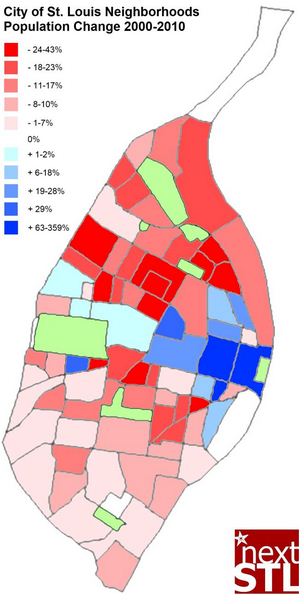
Source: nextSTL.com
In some City neighborhoods, improvements in livability have resulted in growth.  Downtown's population, for example, increased 359% from 2000 to 2010, in the face of significant population loss in the City overall.  Downtown's renaissance is directly attributable to improvements in livability, including restored historic buildings, attractive residential options (e.g., the Washington Avenue Loft District), increases in safety, improved streetscapes, and new recreational options (e.g., Citygarden).  As a result, downtown St. Louis has become a place where urban birds want to, and do, live.

On the other hand, population has decreased in some neighborhoods despite what, by most accounts, would be considered to be significant improvements in livability.  On the City's near south side, for example, neighborhoods such as Tower Grove East, Shaw, and Fox Park saw significant "pop drops" even while "acquiring the trappings of urban revitalization."  In these neighborhoods, population growth is either merely lagging improvements in livability (at best), or is held back by other overriding, negative dynamics despite such improvements (at worst).

So what conclusions can we draw?  For one, there obviously are negative dynamics that will continue to preclude growth in the City irrespective of improvements in livability made to this or that neighborhood.  Most obviously, the City will continue to lose families in the absence of quality, affordable school choices.  Charter schools, while controversial, are certain to be instrumental in reversing the flow of families out of the City. (Jeff Rainford, Chief of Staff to Mayor Slay, recently noted on Twitter that "[i]f not for charters, the City would have lost at least another 15,000 people.").

Perhaps as importantly, growing the urban core will ever be an uphill battle so long as we are not briskly adding to the population of the region as a whole.  Population growth (or even stabilization) in the City can only be achieved by stemming the outflow of current residents and by capturing a reasonable percentage of new residents that are moving into the region at a faster-than-current rate.

The "10% Solution" might work in a
region of strong growth, but what
about in barely-growing St. Louis?
Last year, Aaron Renn, an urban analyst writing as The Urbanophile, laid out a "10 percent solution for urban growth" in Rustbelt-type cities (also discussed here).  The "10% solution" simply means that a region such as St. Louis should "seek to capture about 10% of net new regional growth for the urban core."  While seemingly unambitious, Renn makes a case for the 10% solution being not only achievable, but "utterly transformative."

But what about in a region like St. Louis where overall population growth is abysmal?  Unless our overall region begins growing at least at an average rate, and a meaningful percentage of new residents are attracted to the core, it will be difficult to achieve a critical mass of City (or even County) residents to turn around the population losses of the past.  As Renn states:
 "Obviously [the 10% solution] only works if your region is growing.  If you are stagnant or shrinking, you've got a bigger challenge on your hands.  There the imperative is to restart the regional economic and demographic engine. Hopefully the core can play a role in doing that."
Strengthening the Region for All St. Louisans

So how does St. Louis strengthen the region as a whole?  We could start by actually implementing some of the "old" ideas discussed above, rather than just talking about them.  We also should vigorously pursue the modest-but-measurable goals set forth in the Regional Chamber and Growth Association's latest five-year plan, which calls for St. Louis "to rank consistently in the top half of the nation's big metro areas on various economic measures." Successfully implementing the RCGA's plan to achieve its goals (primarily through measures to attract workers and entrepreneurs) will require concerted efforts at the municipal, county, and state-wide levels. 

But Renn is surely correct that the urban core will have a role in "restart[ing] the regional economic and demographic engine" of St. Louis, and a key one at that.  The nation-wide trend lines are clear: an ever-growing number of residents (and even businesses) value centrally-located, walkable, mixed-use neighborhoods.  Whether or not the bulk of our region's current residents want to live in or near the City, we cannot hope to attract these future generations of urban birds without a strong core.  For me, this is not a "city v. suburbs" mentality; if we can successfully shape the City to bring more residents and businesses to "St. Louis", it ultimately will benefit all of the region, not just the City itself.

Interestingly but not surprisingly, then, St. Louis faces the same chicken-and-egg problem facing other Rustbelt cities.  Without a healthy urban core, it is difficult to grow the entire region by attracting the next generation of residents and businesses; healing the core, in turn, is an uphill battle unless the region as a whole is strong and growing.  The future of St. Louis depends on an interdependent and symbiotic relationship between the City and the rest of the region, and strengthening St. Louis as a whole requires focused attention on both.

A Call to Action

"Rethinking" or "new thinking" for St. Louis' future can mean different things, then, depending on the issue being addressed.  People will, and should, disagree about what ideas are more or less worthy of our collective attention.  It seems clear, though, that identifying ways to make our urban core more livable and implementing ideas to grow the region as a whole are equally important.

What is even more critical is that St. Louisans move beyond just "thinking" about these issues, and begin doing. It will be difficult to reverse the downward trend of the past decades, but, with sustained action, not impossible.  Key efforts are already underway.

In my view, a critical component of turning big ideas into future-changing actions is close cooperation among different "factions" of St. Louisansthe City, County, and other regional entities; Republicans and Democrats; different races and ethnicities, particularly the black and white communities; the public and private sectors; and the so-called "old guard" and the "new guard" of community and political leaders.

On that last item, I'm certain that some disagree, preferring instead a "revolution" against the perceived failures of current leadership and a "now we're going to do it my way" mentality. It is not difficult to understand; for those who have long worked hard to make St. Louis a better place, the Census results were crushingly disappointing and frustrating.

But if the Census has taught us anything, it's that weall St. Louisansare in this together.  I believe that it is incumbent on our "old guard" leaders (political and otherwise) to engage seriously with the "new guard" thought leaders of St. Louis in determining our future direction, and that the "new" must engage the "old" to maximize the likelihood of success of their efforts.  Now is the time for work, and if people remain unsatisfied with the direction our region is headedwell, as the President has been known to say, "that's what elections are for."

If all of this talk of "inter-faction cooperation" sounds Pollyannish, consider that St. Louis has recently shown the ability to come together on other vital efforts, including the passage by County voters of a sales tax hike for public transit (a cause more typically championed in the urban core), and the (unfortunately unsuccessful) effort to land the 2012 Democratic National Convention, generally supported by Democrats and Republicans alike.

If St. Louis does not face an existential threat per se, it at least stands at a crossroads of the very nature of what "St. Louis" will mean to residents and the world at large in the future.  The Census has given us an enormous wake-up call, and surely can spur other cooperative efforts among unlikely bedfellows.  As Mayor Slay said, "[i]f this doesn’t jump-start regional thinking, nothing will."

Consider also that we surely won't succeed in rebuilding the City and our region without the active participation of many, many St. Louisans.  No white knight is coming to save us; it is up to us.  Every person who professes to care about St. Louis must get actively involved in shaping its future.

That might seen daunting, as it's easy to question how much impact any one person can really have.  But often it just involves taking a first stepresearching an issue, making a call, asking how you can help. Consider: What issues are you passionate about?  What skills can you offer?  Who, or what, do you want to help?

I, for one, love St. Louis as it is.  So I will continue to enjoy, promote, and boost St. Louis, and hope others do the same.  We should be proud of a City (and region) of such rich history, beautiful architecture, diverse neighborhoods, and friendly people.  Like many others, though, I recognize our vastly under-realized potential.  My commitment is to stay involved and engaged in various efforts to help reach that potential over the upcoming years and decades.

What are you going to do to help create a better future for St. Louis, today?


Thursday, January 27, 2011

Ten Great Things about the Plans for the Arch Grounds

On Wednesday night, St. Louis finally got a look at the refined design plans for the proposed improvements to the Jefferson National Expansion Memorial and surrounding areas.  The improvements envisioned by Michael Van Valkenburgh Associates are ambitious and exciting, and will involve an enormous investment in the city and region over the next five years.  Here are the aspects of the plans that I like the best:

1.  Gateway MallPerhaps my favorite aspect of the plan is not on the Arch grounds at all, but rather in downtown's Gateway Mall that extends westward from the Memorial.  The presenters repeatedly pointed to Citygarden as an inspiration for the type of improvements and programming that should be located on the Gateway Mall.  Michael Van Valkenburgh called Citygarden's success "extremely encouraging" and a sign that "something is happening to the cultural values" of St. Louis.  

Kiener Plaza as envisioned by MVVA
Drawing from the 2009 Gateway Mall Master Plan, MVVA plans to build on Citygarden's success by extending the "urban hallway" eastward, through Kiener Plaza, around the Old Courthouse, and to the Arch grounds.  I love that the plan reaches this far into the city, directly addressing the design competition's mandate to reconnect the city to the Arch.

Current plans for the Gateway Mall include "major water play areas" and an old-time carousel in Kiener Plaza; a restaurant similar to New York's Shake Shack (with one suggestion for a Ted Drewes instead); a beer garden/patio area (replacing the original plan for a beer garden/ice rink on the southern end of the Memorial); and other family activities and amenities.  Coupled with the great idea of letting visitors buy Arch tickets at remote kiosks, tourists and residents will have many fun reasons to explore downtown before and after visiting the Arch. 

2.  Museum ImprovementsThe west-facing glass entrance to the Museum of Western Expansion will change not only the way visitors enter the museum, but the entire way it is perceived and enjoyed.  The current below-the-Arch entrance is hidden from view and uninviting, with long outdoor queues and a somewhat unpleasant feeling of descending below the ground (which will be mitigated by a ground-level, light-admitting entrance). 

The glass facade will welcome visitors arriving from the Gateway Mall directly into the museum's new front door, creating (in the words of museum architect Scott Newman) an "iconic identity."  The city-facing entrance will engage pedestrians in a way that the current museum (and, unfortunately, buildings on the west side of Memorial Drive) currently does not.  Inside the museum, visitors will find a new lobby; two stories of both new and renovated gallery, event, and educational space; upgraded retail amenities and restrooms; and rotating exhibits to encourage repeat visits.

Gateway Geyser Pavilion, as envisioned by MVVA
3.  East Side ImprovementsMVVA anticipates expanding the Memorial footprint on the east side of the river by fifty to sixty acres.  A 100,000 square foot pavilion will be constructed around the existing Gateway Geyser, with the elevated walkway shown in MVVA's original plan to be completed after Illinois Route 3 is completed in 2016. 

Although relatively understated, these improvementscoupled with new ways to get across the Mississippi (gondolas!)will begin activing the Illinois side of the river in entirely new ways.  I love the idea of people enjoying the city from across the river, and hope that it will help catalyze improved relations with Illinois and a better future for the city of East St. Louis.

4.  C2R-CompatibilityIn its original design narrative, MVVA said that "the benefits of removing the [downtown] highway altogether are clear, and we have purposely created a proposal that is compatible with" highway removal.  The updated design does not include immediate highway removal (not surprisingly), but City to River has shown how the proposed boulevard could work with the proposed pedestrian "lid" that will extend from Luther Ely Smith Square to the Arch grounds. 

MVVA's proposed closure of Memorial Drive makes the boulevard even more critical in order to faciliate circulation throughout downtown via a connected street grid.  City to River will continue to work toward the longer-term goal of removing the downtown highway, and believes that this can be accomplished in the years shortly following completion of the initial improvements.

Improved Memorial landscaping as envisioned by MVVA
5.  Landscaping.  Although it's not the kind of improvement that is likely to get a lot of "buzz" (particularly compared to the gondolas!), I really like the plans for updating the landscaping throughout the Memorial and the Gateway Mall.  Approximately 12,000 trees will be planted, including those that will replace ashes currently threatened by the emerald ash borer beetle.  The trees on the Gateway Mall will be "shade trees"large, fast-growing, and deciduous.  Both the respite from the summer sun and the views of the tree allees along the Mall and in Luther Ely Smith Square will be welcome additions.

Inside the Memorial, the areas around the north and south ponds will be turned into lush meadows with denser tree plantings.  As described by Michael Van Valkenburgh, denser landscaping will result in more wildlife and a richer experience for visitors, consistent with the never-implemented visions of Dan Kiley and Eero Saarinen.
 
6.  Eads Bridge.  This point falls more in the category of things that I hope to love about an even further revised design.  On a disappointing note, MVVA's plan currently does not call for dedicated pedestrian/bicycling lanes over the Eads, but hopefully that will get worked out over time.  And although the closure of Washington Avenue east of Memorial Drive seems unnecessary and contrary to the goal of increased connectivity, its removaltogether with the welcomed demolition of the behemoth parking garagewill make pedestrian access to the northern end of the park through the bridge's portals much more inviting.   

Visitors will enter the northern end of the Memorial
through the Eads Bridge portals, as envisioned
by MVVA
The Eads Bridge is absolutely breathtaking, and provides great city views from the existing walkway.  My hope is that, in the end, the improvements will result in more people (particularly bicyclists and pedestrians) being on and around the bridge, and that it will be widely recognized as being as important to the city's riverfront as is the Arch itself.

7. Old Courthouse. Van Valkenburgh stressed that, in MVVA's view, the Old Courthouse is to be as revered as the Arch, and that together the two icons create a great "urban moment." The courthouse will be updated with 13,000 square feet of renovated gallery and exhibit space, and made ADA-compliant. 

Coupled with the re-energized areas around the courthouse (the improved east-west hallway, and landscaped slope from Luther Ely Smith Square to the new pedestrian lid), these improvements should result in many more visits to the courthouse itself, and a greater appreciation for its importance to the history of St. Louis.

8.  TimingOne of the most exciting aspects of this enormous project is that it's not something that's going to happen much later in St. Louisans' lives, or in our children's lifetimesit is going to be completed within five years.  This is a hugely ambitious deadline given the current economic situation, and some design features (gondolas??) will surely be dropped and deadlines missed.  Nonetheless, given the high level of support for the project in the private sector and at all levels of government, it is hard to imagine that the bulk of MVVA's vision won't be realized over the course of just the next few years.

9.  "Co-Promotion"St. Louis may not fall in the category of what some refer to as a "world-class" city (think: NYC), but it unquestionably has numerous world-class features.  Besides the Arch, the St. Louis region includes parks and attractions that could compete with their counterparts anywhere in the world:  to name only a few, the spectacular Missouri Botanical Gardens, the beautiful and diverse Forest Park, and the archaeological treasure of Cahokia Mounds.  Walter Metcalfe (whose efforts were vital in organizing the competition and securing key political support) raised the notion of the Arch grounds improvements as being a jumping-off point for co-promoting all of St. Louis' other great assets to the rest of the world, which would be a great result.

The purpose of this particular competition was to connect the City to the Arch to the River.  My hope is that the rest of St. Louisparticularly the beautiful, diverse neighborhoods of the urban coresimilarly becomes better connected in the not-too-distant future.  As St. Louis continues to invest in its key assets, and to better connect those assets through public transit, trolley lines, and/or walkable communities, the rest of the world (including desperately-needed employers and employees) will better be able to see the beauty and potential of our home.  Can this competition jump-start other efforts at connectivity and regional cohesion?  I hope so.

10.  Gondolas!  OK, so I was wrong.  In a post last fall, I predicted that none of the "big-ticket, eye candy items" from other teamsspecifically, the gondolaswould be included in MVVA's final design.  And when Behnisch Architekten first proposed gondolas in its losing design entry, my first thought was "Hey, this ain't Disneyland."  To me, the concept seemed gimmicky, an unwise use of funds, and inconsistent with the idea of respecting the Arch as the unquestioned centerpiece of the Memorial.  The futuristic, fanciful depictions included in Behnisch's renderings didn't help.

The gondola(!) route envisioned by MVVA

My initial reactions have been tempered a bit by MVVA's design, and I'm starting to come around to the view held by those who find the gondolas to be one of the most compelling aspects of the updated design. The one-mile gondola line will cross the river along the Poplar Street Bridge, before turning east and leading to the center of the east side improvements. This location and height should minimize interference with views of the Arch. The gondolas are expected to be separately funded through the sale of bonds, supported by revenues from its operations (at least I assume that general obligation bonds would be off the table).

Assuming that the gondolas are appropriately deferential of the Arch and aren't a money-loser for local or state government . . . well, then, I suppose I'm on board (collective sighs-of-relief from MVVA, the National Park Service, and Mayor Slay's office).  Without a doubt, gondolas (including some glass-bottomed ones) crossing the Mississippi River will be a major tourist draw, provide excellent new views of the St. Louis region, and be a LOT of fun. 
___________________________________________________________________________________
October 28, 2015, can't come quickly enough.  As emcee Carol Buck said, the Arch grounds project will add to downtown's existing renaissance, and as brother Joe said (via video), now is the time for the Show-Me State to "show them" that we can get it done.  I believe that we can get it done, and will get it done.  As I have said many times before, it is a truly exciting time for St. Louis.  Indeed, only one word comes close to capturing the enthusiasm and wonder felt by most St. Louisans as we embark on this historic endeavor . . . . . GONDOLAS!?!

For more detailed information on the MVVA design plan, take a look at the website of the CityArchRiver 2015 Foundation, coverage from the Post-Dispatch and Beacon, and ongoing comprehensive analsyis from UrbanSTL.

Monday, January 17, 2011

Photographing St. Louis

In a post this last fall, I said that I intended for this site to continue to be more of a written blog than a photoblog.  Although that remains true, the fact that I have been spending an inordinate amount of my spare time these last few months taking photographs around St. Louis means that I have had very little time to write.  Luckily, the days are starting to get longer so I soon will have more time. (I'm obviously joking, but I swear I had someone say that to me once).

St. Louis is a never-ending source of inspiration for an aspiring photographer.  I could (and do) spend hours on end exploring and photographing the city's distinct and diverse neighborhoods, beautiful parks, and riverfront (including, of course, the magnificent Arch). 

One of my primary (non-work/non-family) goals of 2011 is to continue to capture and share scenes from the city.  I find the creation of photographs to be incredibly fulfilling in its own right, but my interest in photography goes beyond that.  For me (a non-native St. Louisan), photographing St. Louis has become my way to really see the city, to get a better sense of its myriad neighborhoods, and to get a self-taught history lesson about the subjects I am photographing.  I hope to greatly increase the breadth and depth of my subjects in the upcoming year.

Here are some of my favorite photographs from the last few months.  As always, my apologies to my followers on Twitter and Flickr who likely have seen some or all of these before.  I hope to better integrate this site with those accounts in the near future. 


"Fountain in the Ruins"
The faux ruins and fountain pond at Tower Grove Park.
Created by park founder Henry Shaw in 1872/73,
and restored in summer 2010.


"Flurries"
Snow blows outside the World's Fair Pavilion in St. Louis' Forest Park.


"Missouri Tall Grass Redux"
The historic Eads Bridge. The sculpture in the foreground is
"Missouri Tall Grass" by Robin Murez (1999), commissioned by
The Laclede's Landing Foundation (Commercial and Historic Area
Public Art Program).


"Winter Morning at Grand Basin"
On a recent snowy morning, with the Saint Louis Art Museum
 in the background.


"Trolley to the Museum"
A 2.2-mile electric-hybrid trolley line is scheduled to be completed
in fall 2012, running from the western end of the Delmar Loop to
the Missouri History Museum in Forest Park (via DeBaliviere).
For ADA-accessibility reasons, replica streetcars will be used
rather than this heritage Peter Witt vehicle.


"Locomotion"
Looking east from St. Louis' Jefferson Avenue.


"Cold Steel"
The Gateway Arch on a frigid January morning.
"Dusk on Jefferson Avenue"
A view to the southwest from St. Louis' Jefferson Avenue, at dusk.


"Another Man's Treasure"
In the basement of Retro 101 on one of St. Louis' best streets, Cherokee Street.


"Downtown at Dawn"
Downtown St. Louis, shortly before sunrise.


"Outside the Cage"
This flower appeared to be trying to escape the World's Fair Flight
Cage at the St. Louis Zoo, photographed from outside the Zoo.

"Bench in Tower Grove Park"
A black and white version of a photograph I published
on this site in fall 2010.


Sunday, December 5, 2010

St. Louis Desaturated

Late fall and the winter provide great atmospherics for black and white photography.  I feel like B&W captures a certain subtle melancholy that is associated with this colder, darker time of the year, while continuing to reflect the underlying beauty of the subject. 

Here are some recent pictures from around the City of St. Louis (click on pictures for larger versions).  I hope you agree that it doesn't need to be sunny or warm to get out and enjoy the scenery!

A bridge over Pagoda Lake in Forest Park, near The Muny.

"Washed Ashore"
St. Louis' cobblestone levee on a recent foggy morning,
with the historic Eads Bridge in the background.

"For the Birds"
Some of the abundant bird life at Tower Grove Park,
taken at the "ruins" and fountain pond.
"To the Arch"
The path from the northern end of the Jefferson
National  Expansion Memorial to the Gateway Arch,
on a foggy morning.

"Into the Mist"
The Gateway Arch on a recent foggy morning.

"The Return"
This is "The Captain's Return," adjacent to the Eads Bridge.
This is the explorers' (and dog Seaman's) return to St. Louis after a 2+ year
journey to the West, on September 23, 1806.


The landmark Wainwright Building in downtown St. Louis. 
Some may consider it heresy to take the red out of the red brick for this
picture, but I like how it focuses the eye on just the building's form and
detail work, particularly the highly ornamented cornice.

"Silver Morning"
The Gateway Arch from the Eads Bridge, early morning.
  
The faux ruins and fountain pond at Tower Grove
Park.  Created by park founder Henry Shaw in
1872/73, and restored in summer 2010.
 
"Frogger"
This sculpture, along with the nearby turtle, are the works of Bob
Cassilly, creator of the amazing St. Louis City Museum. 
Located in the playground of Lafayette Park.

"Edge of the Park"
This iron fence is located along the eastern edge of Lafayette Park in St. Louis.
The fence and stone gates were designed by Francis Tunica and erected in 1869.


"Into the Storm"
This statue, "Apotheosis of St. Louis," stands at the top of Art Hill in Forest Park, in front of the Art Museum. The statue, of Saint Louis, King Louis IX of France, was originally cast by Charles H.Niehaus and later cast in bronze by the W. R. Hodges firm. The original plaster statue stood at the entrance of the 1904 World's Fair. The final bronze work was unveiled on October 4, 1906, and was the symbol of the City of St. Louis, until completion of the Gateway Arch.

"The Rockery"
The Rockery in St. Louis' Lafayette Park was built in 1866. According to the park's website,
"Only one Iron Bridge remains of two that replaced rustic bridges lost in the Cyclone of 1896."